
How to Recognize a Sarcasm Deficiency in Your Community
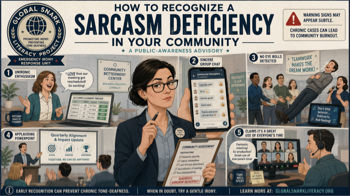
Sarcasm deficiency is a preventable condition, and yet it persists — quietly, insidiously, and often at your local Parks and Recreation open house. The Global Snark Literacy Project has spent the better part of a fiscal quarter cataloguing the early warning signs so that you, the concerned bystander, can intervene before it’s too late.
Symptom one is unironic enthusiasm. Watch for community members who describe a rescheduled meeting as “actually kind of exciting.” This is not a joke. They mean it. Left untreated, this can progress to describing a spreadsheet as “beautiful.”
Symptom two is sincere group chats. A healthy group chat maintains a baseline hum of gentle despair. A deficient one features thumbs-up emojis used without irony, responses that directly address the question asked, and, in advanced cases, someone typing “sounds good!” and meaning it.
Symptom three is the absence of eye rolls at team-building events. This is the diagnostic gold standard. Enter any trust fall, escape room, or mandatory karaoke night and observe the room. A sarcasm-healthy community will produce, on average, one eye roll per participant per twelve minutes. Zero eye rolls indicates either total sarcasm deficiency or a room full of people who have simply given up, which our clinicians assure us is a different, unrelated condition.
Other red flags include applauding a PowerPoint, using the phrase “circle back” without visible discomfort, and referring to a fourth consecutive Zoom call as a “great use of everyone’s time.”
If you’ve identified a sarcasm deficiency in your community, do not panic. The Emergency Irony Response Unit recommends a measured intervention: a raised eyebrow, deployed calmly, from a safe distance. Do not attempt full-strength deadpan on an untrained population — this can cause confusion, over-explanation, or, in rare cases, someone asking “wait, are you being sarcastic?”, which is itself Stage Four.
Recovery is possible. With patience, modeling, and consistent exposure to restrained disapproval, even the most sincere among us can learn to say one thing while meaning, unmistakably, another.